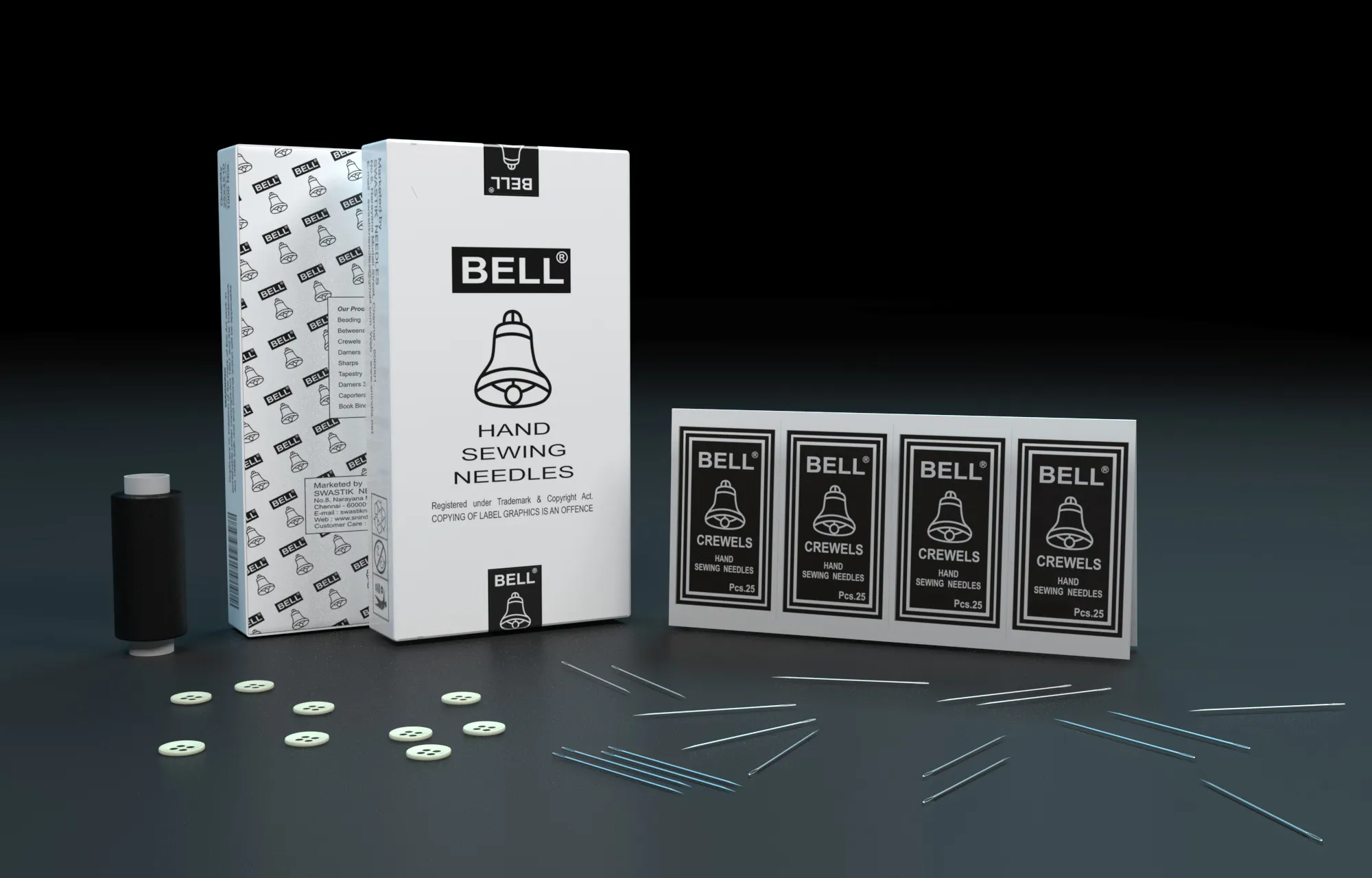
Walk into any sewing supply shop and the sheer number of hand needle varieties can be overwhelming. Crewels, sharps, betweens, tapestry, beading, darners — they all look similar at first glance, but each is engineered for a specific task. Using the right needle makes your stitching faster, neater, and easier on both the fabric and your hands. This guide covers every major Bell hand sewing needle type, what it is designed for, and how to choose between them.
How to read a hand sewing needle: size, length, and wire diameter
Before diving into types, it helps to understand how hand needle sizing works — because it is the opposite of what most people expect.
Higher number = smaller needle. A size 12 crewel needle is significantly finer than a size 1. This applies across almost every hand needle type.
Bell hand needles are specified by three measurements:
- Size number — the larger the number, the shorter and finer the needle
- Length (mm) — the total length of the needle
- Wire diameter (mm) — the thickness of the steel at the blade
For example, a Bell Crewel size 5 is 42mm long with a 0.8mm wire diameter. A Bell Crewel size 12 is just 29mm long with a 0.45mm wire diameter. Same needle type, very different scale.
Bell Crewels — for embroidery and general hand sewing
Best for: Embroidery, crewelwork, general hand stitching with standard or stranded thread
Crewel needles have a medium length and a long oval eye, which makes them easy to thread — especially with thicker embroidery thread, wool, or multiple strands of floss. The sharp point penetrates tightly woven fabric cleanly.
Bell Crewels are available in sizes 1 through 12. Size 1 is the largest at 49mm; size 12 is the finest at 29mm. Most embroiderers start with size 5, 6, or 7 for general work.
| Bell code | Size | Length (mm) | Wire dia (mm) |
|---|---|---|---|
| BC1 | 1 | 49 | 0.85 |
| BC5 | 5 | 42 | 0.80 |
| BC7 | 7 | 38 | 0.70 |
| BC9 | 9 | 35 | 0.50 |
| BC12 | 12 | 29 | 0.45 |
Bell Sharps — for precise everyday hand sewing
Best for: General hand sewing, hemming, sewing on buttons, appliqué, fine hand stitching
Sharps are the most versatile hand needle. They have a small, round eye and a fine, sharp point — ideal for making neat, controlled stitches in woven fabrics. They are the needle most people picture when they think of hand sewing.
Bell Sharps run from size 1 (46mm) down to size 10 (32mm). For general sewing, sizes 7 and 8 are the most popular.
| Bell code | Size | Length (mm) | Wire dia (mm) |
|---|---|---|---|
| BS1 | 1 | 46 | 0.80 |
| BS3 | 3 | 40 | 0.80 |
| BS6 | 6 | 40 | 0.80 |
| BS8 | 8 | 36 | 0.60 |
| BS10 | 10 | 32 | 0.45 |
Bell Betweens — for quilting and fine tailoring
Best for: Hand quilting, fine tailoring, detailed hand stitching requiring tight control
Betweens (sometimes called quilting needles) are shorter than sharps of the same size, with a round eye and a sharp point. The shorter length gives quilters and tailors greater control over each stitch, making them the preferred choice for running stitches through multiple layers of fabric.
Bell Betweens are available in sizes 5 through 9 (34mm down to 27mm).
Bell Darners — for mending and repair
Best for: Darning worn fabric, mending knitwear, repairing socks and wool garments
Darner needles are longer than most hand needles, with a long eye that accommodates yarn or thick thread. Bell offers two main variants:
- Bell Darner (Short) — sizes 5 through 12, ranging from 52mm down to 36mm. Good for standard darning on cotton and lightweight wool.
- Bell Long Darners and Double Long Darners — sizes up to 88mm (3/0) with a 1.8mm wire diameter. These are designed for mending heavy fabrics, basting layers together, or working with thick yarn.
The Bell Capotera (size 6/0, 63mm) and Darners 3½ (89mm) are even larger specialty darners for heavy-duty textile repair work.
Bell Tapestry — for canvas work and cross stitch
Best for: Tapestry, cross stitch, needlepoint, canvas embroidery
Tapestry needles have a blunt tip rather than a sharp point. They are designed to pass between the threads of an open-weave canvas or evenweave fabric without splitting them. The large eye accommodates wool, tapestry thread, or thick embroidery floss.
Bell Tapestry needles are available in sizes 18G (49mm) and 19G (45mm). Bell also offers a Chenile needle — a pointed tapestry needle (code BT18P) for fabrics that require penetration rather than thread separation.
Bell Beading — for beads and sequins
Best for: Threading seed beads, sequins, and small beads onto fabric
Beading needles are very long and extremely fine, with a tiny eye that can pass through the hole of even the smallest seed bead. Bell Beading needles come in sizes 10, 11, and 12 — the finest being size 12 at 51mm with a 0.40mm wire diameter.
These are not general-purpose needles. They are fragile by design and should be used only for bead and sequin work.
Bell Book Binder — for bookbinding and heavy material
Best for: Bookbinding, heavy canvas, leather binding work
Book Binder needles are thick, heavy-gauge needles with a large eye, available in lengths from 76mm (size 3) up to 204mm (size 8). Bell Book Binders come with a wire diameter of 1.8mm — significantly heavier than any standard sewing needle — and are used specifically for binding work.
Bell Compact assorted sets — the household starter kit
If you are new to hand sewing or want a complete household repair kit, Bell's Compact needle sets are the easiest starting point. The Bell Compact (BNCC, BNC) packs contain 25–30 assorted needles covering sharps, darners, and embroidery types, with a needle threader included. The Bell Compact Gold Eye (BNCG) version adds gold-eye needles for easier threading.
Quick-pick guide: craft to needle type
| What you are doing | Needle type | Bell code range |
|---|---|---|
| Embroidery / crewelwork | Crewels | BC1–BC12 |
| General hand sewing, hemming | Sharps | BS1–BS10 |
| Hand quilting | Betweens | BB5–BB9 |
| Darning / mending | Darners (Short / Long) | BD5–BD12, B3/0 |
| Cross stitch / canvas | Tapestry | BT18, BT19 |
| Beads and sequins | Beading | B10–B12 |
| Basting, layering | Double Long Darner | BDLD5, BDLD6 |
| Bookbinding / heavy canvas | Book Binder | BBB3–BBB8 |
| Household repairs (starter) | Compact assorted | BNCC, BNC, BNCG |
Frequently asked questions
What is the difference between a crewel needle and a sharp needle?
Crewels have a longer, oval eye to hold embroidery thread or multiple strands of floss. Sharps have a smaller, rounder eye and are designed for neater stitching with a single thread in woven fabric. If you are embroidering, use a crewel. If you are hemming or sewing on a button, use a sharp.
What needle is used for quilting by hand?
A "between" needle — shorter than a standard sharp, with a round eye and a fine point. The shorter length gives quilters more control for making even running stitches through multiple layers of fabric and wadding.
Do bigger needle numbers mean bigger needles?
No — it is the opposite. In hand sewing, the larger the size number, the smaller and finer the needle. A size 12 crewel is much shorter and finer than a size 1. This trips up a lot of beginners.
What size beading needle do I need?
Size 12 (0.40mm wire diameter) is the standard for seed beads. Use size 10 or 11 for slightly larger beads or when using thicker beading thread. Note that beading needles are fragile — they are designed only for bead work.
Can I use a tapestry needle for cross stitch?
Yes — tapestry needles are the correct needle for cross stitch. The blunt tip passes between the weave of the evenweave or aida fabric without splitting the fabric threads, which gives you clean, even stitches.
What hand needle size is best for beginners?
A Bell Sharp size 7 or 8, or a Crewel size 7, is the most forgiving starting point. They are mid-length, have an eye that is easy to thread, and work across a wide range of common fabrics and projects.
Bell hand sewing needles are manufactured by Swastik Needles (ISO 9001:2015 Certified), Chennai, India. Available in 27+ countries.