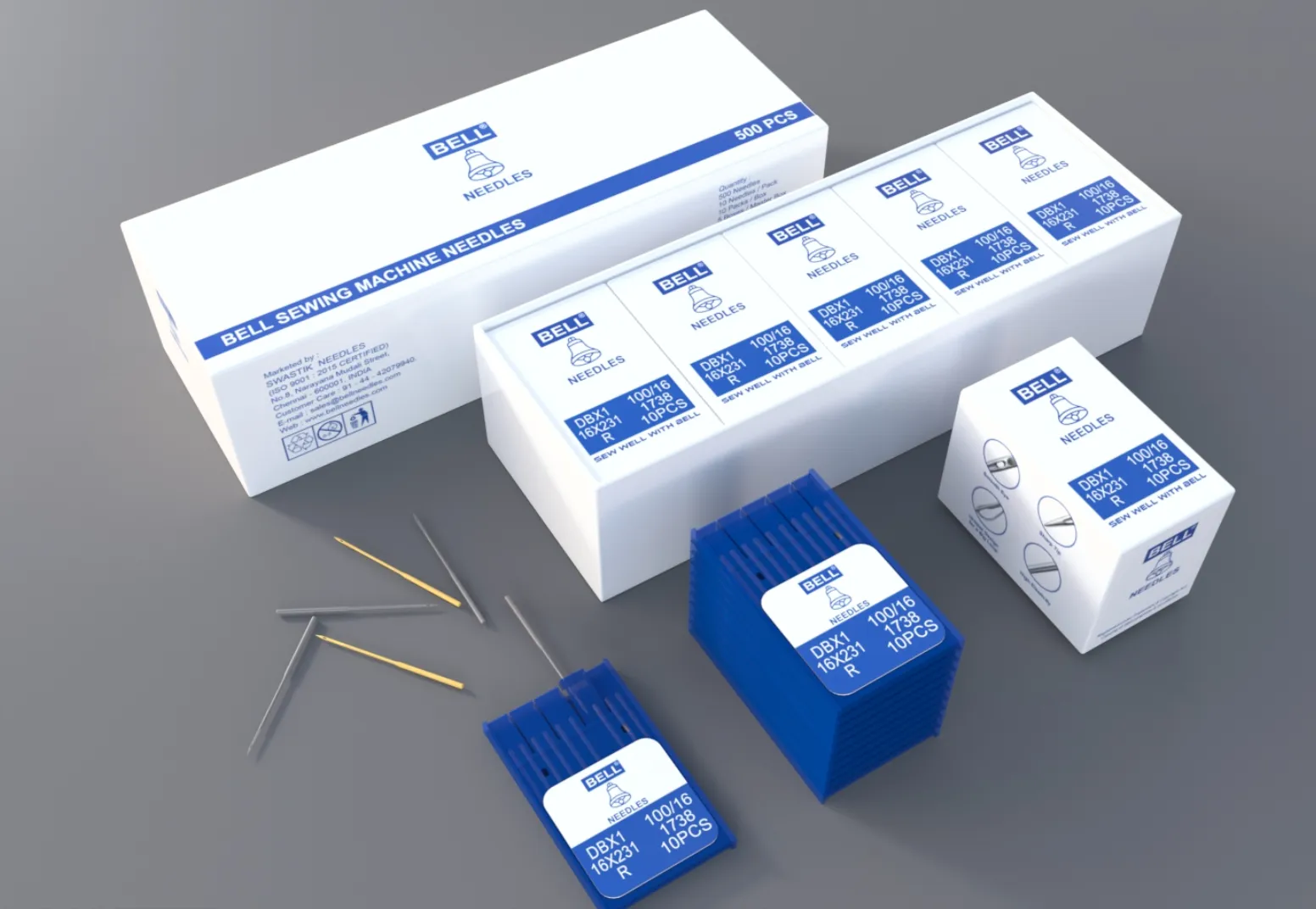
Choosing the wrong needle size is one of the most common — and most fixable — sewing mistakes. Skipped stitches, shredded thread, pulled fabric: in most cases, the culprit isn't your machine settings or your technique. It's the needle. This guide walks you through everything you need to know about sewing machine needle sizes, from how to read the numbers on the packet to exactly which Bell needle to reach for depending on your fabric and machine type.
What do the two numbers on a sewing machine needle mean?
Every sewing machine needle packet shows two numbers, for example 100/16. These refer to two sizing systems used in different parts of the world — but they describe the same needle.
- The metric (NM) number — the first number (e.g. 100) refers to the diameter of the needle blade in hundredths of a millimetre. A 100 NM needle has a blade diameter of 1.00 mm.
- The imperial number — the second number (e.g. 16) is the older US/UK sizing system. It doesn't map linearly to millimetres, but the two always appear together so you can match either.
The rule is simple: the higher the number, the thicker the needle. A 65/9 is fine and delicate; a 200/25 is heavy-duty industrial.
Bell sewing machine needle size chart
Here is a quick-reference guide covering the full Bell needle size range, the fabrics each size is suited for, and the machine context:
| Needle size | Fabric weight | Typical fabrics | Machine type |
|---|---|---|---|
| 65/9 | Ultra-fine | Voile, batiste, lightweight cotton | Home / Industrial |
| 70/10 | Fine | Lingerie, silk, fine knits | Home / Industrial |
| 75/11 | Light | Poplin, soft knits, polyester | Home / Industrial |
| 80/12 | Light–medium | Cotton, linen, satin, jersey | Home / Industrial |
| 85/13 | Medium-light | Stretch cotton, thin denim | Home / Industrial |
| 90/14 | Medium | Dressmaking fabrics, quilting | Home / Industrial |
| 95/15 | Medium-heavy | Canvas, upholstery fabric | Home / Industrial |
| 100/16 | Heavy | Thick denim, heavy upholstery, vinyl | Home / Industrial |
| 110/18 | Very heavy | Outdoor fabrics, workwear | Industrial |
| 120/19 | Extra heavy | Industrial stitching, bag making | Industrial |
| 125/20 | Thick | Heavy canvas, multiple leather layers | Industrial |
| 140/22 | Extra thick | Military gear, heavy-duty sewing | Industrial |
| 160/23 | Industrial heavy | Saddlery, marine textiles | Industrial |
| 180/24 | Super heavy | Automotive, ship sails | Industrial |
| 200/25 | Maximum | Extra-thick leather, rigid materials | Industrial |
Home machines vs industrial machines: HAX1 vs DBX1
Beyond needle size, the needle system matters just as much. Needle systems define the shank shape, blade length, and groove position — and a domestic needle will not fit correctly in an industrial machine, and vice versa.
- Bell HAX1 (also labelled 15X1 / 130/705H) — the standard needle for domestic sewing machines. It has a round shank and is compatible with virtually all home machines from major brands. Use this for garments, quilting, and everyday projects at home.
- Bell DBX1 (also labelled 16X231 / 1738) — the standard needle for industrial lockstitch machines used in garment factories and tailoring units. It has a flat shank and is engineered for high-speed, continuous sewing.
Both are available in the full size range shown above, from 65/9 through to 200/25 depending on the system.
Standard vs gold needle: when is the upgrade worth it?
Bell also offers gold titanium-coated versions of both the DBX1 and HAX1 — the Bell DBX1 Gold and Bell HAX1 Gold.
Gold needles run cooler due to the titanium coating, which reduces friction at high speeds. They last significantly longer than standard needles and are the right choice when:
- You are running an industrial machine at sustained high speed
- You are sewing heat-sensitive fabrics that show friction damage
- You are working with synthetic threads that melt or shred at high temperatures
- You want a longer service life between needle changes to reduce downtime
For occasional home sewing, the standard needle is perfectly sufficient. For production environments, gold is a worthwhile investment.
5 signs you are using the wrong needle size
- Skipped stitches — usually caused by a needle that is too fine for the fabric, or a bent needle tip that is missing the bobbin hook timing window.
- Thread keeps breaking — the eye of the needle may be too small for the thread, causing friction and shredding.
- Fabric puckering — often means the needle is too heavy for a lightweight fabric, pushing too much material aside with each penetration.
- A popping sound when the needle enters the fabric — the needle is too thick and is forcing its way through rather than piercing cleanly.
- Visible holes left in the fabric — same cause as above; reduce the needle size to match the fabric weight.
Quick-pick guide by fabric type
- Voile, silk, chiffon → 65/9 or 70/10
- Cotton, linen, jersey → 80/12
- Denim (light) → 90/14
- Denim (heavy), canvas → 100/16
- Upholstery, outdoor fabrics → 110/18 to 120/19
- Leather, vinyl → 100/16 to 140/22 depending on thickness
- Industrial heavy-duty (sails, tarps) → 160/23 to 200/25
Frequently asked questions
What is the most common sewing machine needle size?
For general garment sewing, 80/12 is the most commonly used size — it works well with cotton, linen, satin, and jersey. For slightly heavier fabrics like denim or canvas, 90/14 is the go-to choice.
What does DBX1 mean on a sewing needle?
DBX1 is the needle system code for industrial lockstitch machines. The codes 16X231 and 1738 refer to the same needle in different labelling conventions — all three can be used interchangeably.
Can I use a domestic needle in an industrial machine?
No. Industrial machines require a specific needle system with a flat shank (such as DBX1), while domestic machines use a round-shank needle (HAX1). Fitting the wrong system can damage your machine and produce poor stitch quality.
How often should I change my sewing machine needle?
A good rule of thumb is every 6–8 hours of sewing time, or at the start of every major project. A dull needle causes more problems than most sewists realise — if your stitches suddenly start skipping or your thread starts breaking, change the needle first before adjusting anything else.
What is a gold sewing machine needle used for?
Gold titanium-coated needles are designed for high-speed industrial sewing. The coating reduces heat and friction, making the needle last longer and protecting heat-sensitive threads. Bell offers DBX1 Gold and HAX1 Gold variants for both industrial and domestic machines.
Bell Needles are manufactured by Swastik Needles (ISO 9001:2015 Certified), Chennai, India. Available in 27+ countries.